Introduction
Finding a professional who can bridge the gap between deep technical systems and high-level business strategy is rare. Often, companies feel forced to choose between a “specialist” (who knows the how but not the why) and a “generalist” (who knows a little bit of everything but masters nothing).
However, there is a third category that is increasingly becoming the secret weapon of high-growth companies: The Polymath.
If your organization is navigating high levels of complexity, here is why a polymathic approach is your most valuable asset. Specifically one that blends technical systems thinking with product and innovation leadership.
What is a Polymath? (Hint: It’s not a Generalist)
The term “polymath” often gets confused with “generalist.” While a generalist skims the surface of many topics, a polymath achieves deep mastery in multiple, seemingly unrelated fields (and most importantly) synthesizes them to solve complex problems.
In a business context, this means having the technical depth to understand a system’s architecture, the strategic mind to see where the market is moving, and the creative ability to tell a story that aligns an entire organization.
The power of Value Multipliers
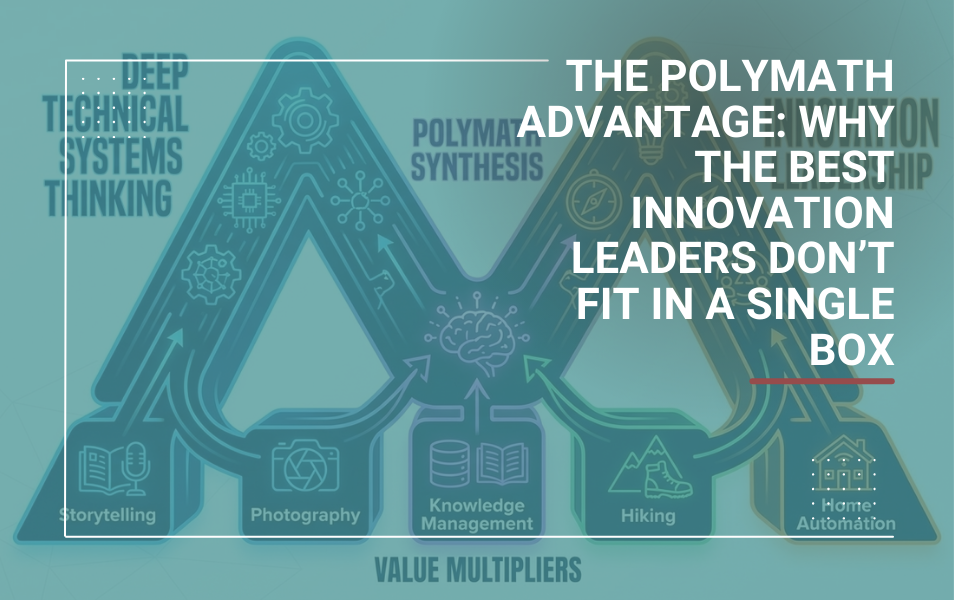
A polymath doesn’t just “have hobbies.” They have value multipliers: interests that feed back into their professional output to sharpen their edge.
In my practice, I blend two core pillars: deep technical systems thinking and business leadership. With a set of multipliers that accelerate results:
Storytelling & photography: I use photography to spot patterns others miss and storytelling to translate “black box” technology into a compelling vision for stakeholders.
Knowledge management: Turning individual insights into “organizational memory” ensures that innovation isn’t just a one-off event, but a repeatable process.
Home automation & systems mindset: My personal interest in home automation serves as a sandbox for testing complex logic and hardware-software integration, sharpening my ability to stay critical and feeding my technical due dilligence skills.
Hiking & mental clarity: High-stakes innovative products require a clear head. Stepping away from the screen allows for the “incubation” phase of creativity, often leading to the breakthrough idea that solves a stale business problem.
Why having polymaths on-board is a strategic advantage
For companies operating in rapidly scaling environments, the polymath provides three distinct advantages:
Faster translation from Intent to Execution: because a polymath speaks “Engineer,” “Product Manager,” and “CEO,” there is less lost in translation. This leads to faster development cycles and fewer “pivot-and-repair” sessions.
Stronger alignment between Tech and Business: a polymath ensures that the technology isn’t just “cool,” but that it serves the bottom line. By applying systems thinking to product strategy, polymaths build foundations that are scalable rather than just functional.
Identifying hidden risks and opportunities: by pulling from diverse fields. Like applying principles of photography (perspective) to a software UI or knowledge management to a technical debt problem. Polymaths see the “blind spots” that specialists often miss.
Key statistic: according to research on organizational behavior, “boundary spanners” (those who can bridge different functional silos) increase team efficiency by up to 30% in complex project environments.
Let’s connect
The job market is flooded with specialists, but if your company is navigating a “wicked problem” that requires a blend of technical depth, leadership, and diverse perspective, a polymath might be exactly what you need.
Are you a hiring manager or recruiter? If you are looking for someone to bridge the gap between your technical and business teams, let’s discuss how my background in innovation labs can drive results for you.
Are you a fellow polymath? I’m always looking to expand my network and share experiences on how to navigate a world that often tries to put us in a single box.
Let’s start a conversation. Reach out to me via link to explore how we can turn complexity into a competitive advantage.